Ghost in the Shell: Stand Alone Complex and 2nd GiG: A
It's kind of absurd that I would even consider posting this review; like Evangelion, Ghost in the Shell as a franchise is so thoroughly embedded in the collective anime-viewers' consciousness that praising it is less preaching to the choir as it is reading a pre-written sermon to people who not only have already heard it, but have gone on to write their Master's theses on the original sermon.
I first encountered Ghost in the Shell in the 90s, as the first movie, which, notably, started out with a naked robot woman being constructed, an extremely memorable scene for a 12-year-old. Some years later, in college, I watched the first season of Stand Alone Complex and felt it was kind of impenetrable but had a really engaging combination of action, science fiction and mystery.
I come back to it after over ten years and realize that while the technological direction that the series took was highly inaccurate (nobody predicted wireless, seriously), the thoughtful transhumanist undercurrent is much more readable and due to my greater patience and focus and the plot is more comprehensible as well, though the extra layer of 'do machines have something identifiable as a soul?' remains unanswered and the final episode of the first season was a little unsatisfying after the blazing action of the rest of the series.
I hadn't watched 2nd GiG, the second season of Stand Alone Complex before, but it loyally continues the story of Public Safety Section 9, providing more insight into the characters and what life in the wired and chromed up 21st century of Masamune Shirow's imagination looks like, a place of politics, violence, corruption and techno-evolution.
The plots themselves are well-crafted and engaging, though you cannot get away with half-watching them, too much happens in heavy dialogue and obscure political institutions. If you do pay attention though it's not particularly hard to follow: the villains and heroes both are recognizable, almost iconic. Despite now being over a decade old, the animation quality holds up very well, looking smooth and crisp even by modern standards.
In short, while I don't believe Ghost in the Shell is mind-blowingly deep, it is extremely intelligent, and completely deserving of its status as one of the big names in anime.
For you fans who didn't know: there is an in-progress OVA series called Ghost in the Shell: Arise, though it uses completely new character designs and voice actors, being a reimagining instead of a sequel.
Showing posts with label A or Better. Show all posts
Tuesday, April 29, 2014
Friday, April 25, 2014
Kyousougiga
Kyousougiga: A+
Once upon a time, there was a monk whose drawings came to life, and so he was asked to live in the country, away from the capital where everyone was afraid of him. He didn't mind so much, but continued drawing things to entertain himself, and one of those things was a black rabbit named Koto, who he created to be the goddess of a city he had created. And that rabbit fell in love with the monk, and a buddha offered to give her a body so that they could move forward with their relationship. And in time, they had three children, only one of whom was particularly human, but they were a family and it was good. Eventually they were given further trouble by the priests and so the monk drew a world for them, and they fled to that world to live.
And then the monk and the woman who had been the rabbit left, and things got weird.
Kyousougiga is a fairy tale with a distinctly Japanese flavor, a very well-paced and well-executed one. What begins as a story about a strange wonderland becomes very directly about freedom, inheritance, growing up, responsibility, family and love. The ending is one of the best I've seen in recent memory.
It's short, only 10 episodes (3 more exist, but they're compilations, live action distractions and commentary), so you can get through it in an evening if you're willing to stretch a little bit, and I recommend watching it in one sitting, because a lot is happening all of the time and if you miss things or forget details, you're likely to be missing pieces when it comes to the conclusion.
I'm inclined to draw a parallel to FLCL for a similar sense of mayhem and a similarly-couched narrative, as well as similar pacing, but Kyousougiga doesn't have FLCL's utter zaniness, so the comparison might not work for some people. Kyousougiga didn't blow my mind quite as brilliantly as FLCL did, but that's not much of an mark against it.
Kyousougiga is beautiful and will make you want to go give your mom or dad or brothers or sisters a hug. It's elegant and clever and conclusive in a way very few anime ever are. It's weird, and the animation is definitely... different, and you really do need to pay attention to it for it all to work, but give it a chance to tell its story. The payoff is worth it.
Sunday, April 20, 2014
Attack on Titan
Shingeki no Kyojin: A*
So I was told to watch a show called "Attack on Titan," acontexually by good friends of mine who don't watch a ton of anime, about seven months ago. Given the name, I assumed it was some kind of sci-fi thing, Titan being the moon of Saturn, and the fact that I hadn't seen the name anywhere else led me to dismiss it. Completely unrelatedly, the anime blogs I follow were completely abuzz with images and praise for this show "Shingeki no Kyojin," but I didn't pick it up at the time. Fast forward a month or two and due to clicking a link on Wikipedia about Shingeki no Kyojin, I learn that Attack on Titan is its english title, and that it's being nearly simultaneously released in the US. Whoopsie me. I downloaded what I could get of it (most of it had already broadcast at the time) and watched the first episode, which, not to spoil, involves our protagonist watching his mother get eaten alive.
At which point I put it back down and said to myself "Right, I'll watch that when I'm in the mood for something that horrific." Fast forward seven months to two days ago when I think "You know, I should watch Attack on Titan sometime soon." At which point I sat down and watched it practically in one sitting.
Attack on Titan is a very even-handed and mature series about fear, war and sacrifice in the face of annihilation. As such, it actually shares many similarities with other apocalyptic scenarios, I personally saw a lot of parallels to Evangelion and 28 Days Later. The artwork is a different style than 'standard' anime, one better suited to the dozens and hundreds of haunted, tortured and terrified eyes that populate a world living in fear. The animation is very smooth, even in the exciting, absurdly high-velocity action sequences and expressive during the periods of intense emotion that I was usually sold on.
The concept is solid and the execution is excellent; the writing, while it has a body count that even George RR Martin might raise an eyebrow at, is overall very good. I have a few points of criticism, though. Pacing is good but entire episodes are often spent providing the background for a single decision, more than once an entire 20-minute episode takes place within 2 or 3 minutes of in-world time. While something important happens every episode there are a couple points where it feels like things have slowed down before we go back to breakneck action. I personally foresaw most of the twists (though I also called at least one twist which wasn't there), which is a pretty minor criticism, really, because it meant that there was enough complexity to the plot to be worth guessing, it just didn't make guessing very hard.
The big complaint though, and this is the reason for that ugly asterisk after Attack on Titan's otherwise perfect grade, is that it doesn't end. It ends at a good pausing point, but if I didn't know that there's going to be a second season (sometime in 2015), I would probably give the series a B+, maybe even lower. The show does an excellent job of engaging us, you really care, maybe not about the characters specifically, but about the very morally ambiguous situation and how it's going to resolve, and the show doesn't have that for you yet.
If you want to watch a show dealing with heavy, emotional and ambiguous themes, imaginatively constructed, laden with action, mystery and visceral horror, a story of a maimed and crippled humanity struggling forward toward the faintest sliver of hope, Attack on Titan is a your mind-blowing, gut-wrenching half-masterpiece. If skinless people, gore, pointless deaths or haunted eyes bother you, I guess you can skip it.
So I was told to watch a show called "Attack on Titan," acontexually by good friends of mine who don't watch a ton of anime, about seven months ago. Given the name, I assumed it was some kind of sci-fi thing, Titan being the moon of Saturn, and the fact that I hadn't seen the name anywhere else led me to dismiss it. Completely unrelatedly, the anime blogs I follow were completely abuzz with images and praise for this show "Shingeki no Kyojin," but I didn't pick it up at the time. Fast forward a month or two and due to clicking a link on Wikipedia about Shingeki no Kyojin, I learn that Attack on Titan is its english title, and that it's being nearly simultaneously released in the US. Whoopsie me. I downloaded what I could get of it (most of it had already broadcast at the time) and watched the first episode, which, not to spoil, involves our protagonist watching his mother get eaten alive.
At which point I put it back down and said to myself "Right, I'll watch that when I'm in the mood for something that horrific." Fast forward seven months to two days ago when I think "You know, I should watch Attack on Titan sometime soon." At which point I sat down and watched it practically in one sitting.
Attack on Titan is a very even-handed and mature series about fear, war and sacrifice in the face of annihilation. As such, it actually shares many similarities with other apocalyptic scenarios, I personally saw a lot of parallels to Evangelion and 28 Days Later. The artwork is a different style than 'standard' anime, one better suited to the dozens and hundreds of haunted, tortured and terrified eyes that populate a world living in fear. The animation is very smooth, even in the exciting, absurdly high-velocity action sequences and expressive during the periods of intense emotion that I was usually sold on.
The concept is solid and the execution is excellent; the writing, while it has a body count that even George RR Martin might raise an eyebrow at, is overall very good. I have a few points of criticism, though. Pacing is good but entire episodes are often spent providing the background for a single decision, more than once an entire 20-minute episode takes place within 2 or 3 minutes of in-world time. While something important happens every episode there are a couple points where it feels like things have slowed down before we go back to breakneck action. I personally foresaw most of the twists (though I also called at least one twist which wasn't there), which is a pretty minor criticism, really, because it meant that there was enough complexity to the plot to be worth guessing, it just didn't make guessing very hard.
The big complaint though, and this is the reason for that ugly asterisk after Attack on Titan's otherwise perfect grade, is that it doesn't end. It ends at a good pausing point, but if I didn't know that there's going to be a second season (sometime in 2015), I would probably give the series a B+, maybe even lower. The show does an excellent job of engaging us, you really care, maybe not about the characters specifically, but about the very morally ambiguous situation and how it's going to resolve, and the show doesn't have that for you yet.
If you want to watch a show dealing with heavy, emotional and ambiguous themes, imaginatively constructed, laden with action, mystery and visceral horror, a story of a maimed and crippled humanity struggling forward toward the faintest sliver of hope, Attack on Titan is a your mind-blowing, gut-wrenching half-masterpiece. If skinless people, gore, pointless deaths or haunted eyes bother you, I guess you can skip it.
Monday, April 7, 2014
Kill La Kill
Kill La Kill: A
Okay apparently it was time for another of my patented 3-month breaks. Not sure that I'm back to full speed, but I finished this series so here we are.
Kill La Kill is the first full-length series by Studio Trigger, formed by a number of Gainax employees who apparently felt that their former company's direction wasn't awesome enough. Most notably its writer did Panty and Stocking with Garterbelt and its director did Gurren Lagann.
It's a show about clothes. It is the most actiony, explosive show about clothes that you could ever possibly imagine. The title is built off the pun that 'kill' in japanese is pronounced 'kiru', which is homophonic with the verb 'to wear'.
For how good a show it is, I find myself wanting to criticize it a lot, mostly because I reflexively compare it to Gurren Lagann, which I will go ahead and say I feel is the best-crafted anime of all time. And while Kill La Kill is very good, it has some modest pacing and commitment issues, there are numerous episodes that, while they don't exactly accomplish nothing, don't advance the plot as much as they could, and places in the series where it could have been written for greater impact. Perhaps my biggest complaint is that the series never delivers on a concise message about what clothing should represent or be used for, a failure to commit to a message.
All that said, it is well-animated, funny and full of over-the-top action while having a varied cast of flavorful, interesting characters. The use of revealing costuming and nudity is quite deliberate (rather than just kind of being there for the ride), and in my opinion doesn't feel like fan service, especially since characters of both sexes are extensively naked.
If Gurren Lagann's slightly underclothed, slightly confused (but still very clever and fun and exciting) little sister sounds like a show you would like, Kill La Kill delivers that same kind of 'what the really' action and laughter, with music that makes you feel like you should go out and cut a truck in half. If seeing a girl wear something that would wedge the hell out of any person with nerves on their lower body will break your suspension of disbelief, or if you really want a show that uses animation to discuss the difficult topics that it might bring to mind in a mature audience, Kill La Kill will feel inappropriate.
Okay apparently it was time for another of my patented 3-month breaks. Not sure that I'm back to full speed, but I finished this series so here we are.
Kill La Kill is the first full-length series by Studio Trigger, formed by a number of Gainax employees who apparently felt that their former company's direction wasn't awesome enough. Most notably its writer did Panty and Stocking with Garterbelt and its director did Gurren Lagann.
It's a show about clothes. It is the most actiony, explosive show about clothes that you could ever possibly imagine. The title is built off the pun that 'kill' in japanese is pronounced 'kiru', which is homophonic with the verb 'to wear'.
For how good a show it is, I find myself wanting to criticize it a lot, mostly because I reflexively compare it to Gurren Lagann, which I will go ahead and say I feel is the best-crafted anime of all time. And while Kill La Kill is very good, it has some modest pacing and commitment issues, there are numerous episodes that, while they don't exactly accomplish nothing, don't advance the plot as much as they could, and places in the series where it could have been written for greater impact. Perhaps my biggest complaint is that the series never delivers on a concise message about what clothing should represent or be used for, a failure to commit to a message.
All that said, it is well-animated, funny and full of over-the-top action while having a varied cast of flavorful, interesting characters. The use of revealing costuming and nudity is quite deliberate (rather than just kind of being there for the ride), and in my opinion doesn't feel like fan service, especially since characters of both sexes are extensively naked.
If Gurren Lagann's slightly underclothed, slightly confused (but still very clever and fun and exciting) little sister sounds like a show you would like, Kill La Kill delivers that same kind of 'what the really' action and laughter, with music that makes you feel like you should go out and cut a truck in half. If seeing a girl wear something that would wedge the hell out of any person with nerves on their lower body will break your suspension of disbelief, or if you really want a show that uses animation to discuss the difficult topics that it might bring to mind in a mature audience, Kill La Kill will feel inappropriate.
Tuesday, October 8, 2013
Houkago no Pleiades
Afterschool Pleiades: A
This is a bit of a weird 'series'. It's about 25 minutes long, in four 'episodes'.
It is excellent. It is about the shortest magical girl story you could possibly have. It has everything a magical girl anime needs: a transformation sequence, a cute mascot, a mysterious pretty boy, and a normal, clumsy girl who risks everything to protect her friends and try to tell him that he's not alone.
And it's good enough that it makes me tear up a little bit at the climax.
I love it, for being a story that is able to tell itself so quickly and so elegantly. If you've ever wanted a reminder that you are not alone in the world, that someone else has seen what you've seen, take a half hour and watch Afterschool Pleiades.
This is a bit of a weird 'series'. It's about 25 minutes long, in four 'episodes'.
It is excellent. It is about the shortest magical girl story you could possibly have. It has everything a magical girl anime needs: a transformation sequence, a cute mascot, a mysterious pretty boy, and a normal, clumsy girl who risks everything to protect her friends and try to tell him that he's not alone.
And it's good enough that it makes me tear up a little bit at the climax.
I love it, for being a story that is able to tell itself so quickly and so elegantly. If you've ever wanted a reminder that you are not alone in the world, that someone else has seen what you've seen, take a half hour and watch Afterschool Pleiades.
Sunday, September 29, 2013
Love Lab
Love Lab: A
Love Lab is a comedy series about middle school girls who have mostly no idea how romance and dating and boys work. This sounds like it would be vapid and terrible. It's actually the most intelligent and clever anime comedy I've seen in a long time.
I could tell you about the five main cast members and how they're all recognizable, but have unique quirks and characterizations that endear them to you, or how the humor isn't afraid to use double-entendres, misunderstandings and genuinely clever situational awkwardness without resorting to predictable bit gags (characters do have their 'bits' but they remain creative about them), or I could even talk about how the series manages to avert a number of major tropes: there are male characters who are important to the plot, there are at least four teachers with distinct names and personalities and we meet multiple characters' parents and families. But instead I'll say that the main story's plot is actually really heartfelt and well-executed, maintaining a sense of tension while remaining believable and having an adorable but still humorous resolution.
Overall, Love Lab is an extremely well-crafted shojo (I think it's shojo? It doesn't have the fan service or all-female cast to be seinen) comedy that doesn't fall into the normal slice of life trap of no plot and no progress. Basically, anyone who wants a laugh and was ever a junior high school student would probably enjoy Love Lab.
Love Lab is a comedy series about middle school girls who have mostly no idea how romance and dating and boys work. This sounds like it would be vapid and terrible. It's actually the most intelligent and clever anime comedy I've seen in a long time.
I could tell you about the five main cast members and how they're all recognizable, but have unique quirks and characterizations that endear them to you, or how the humor isn't afraid to use double-entendres, misunderstandings and genuinely clever situational awkwardness without resorting to predictable bit gags (characters do have their 'bits' but they remain creative about them), or I could even talk about how the series manages to avert a number of major tropes: there are male characters who are important to the plot, there are at least four teachers with distinct names and personalities and we meet multiple characters' parents and families. But instead I'll say that the main story's plot is actually really heartfelt and well-executed, maintaining a sense of tension while remaining believable and having an adorable but still humorous resolution.
Overall, Love Lab is an extremely well-crafted shojo (I think it's shojo? It doesn't have the fan service or all-female cast to be seinen) comedy that doesn't fall into the normal slice of life trap of no plot and no progress. Basically, anyone who wants a laugh and was ever a junior high school student would probably enjoy Love Lab.
Saturday, March 30, 2013
Nanoha The Movie 2nd A's
Nanoha the Movie 2nd A's: A
So I wrote in my original Nanoha A's review that A's is an extremely well-told story with excellent pacing, characterization and a well-crafty story about good people. The Movie version of the same is also excellent, though, frankly, weaker for the exclusion of certain elements in the interest of cutting down on the time.
Since the original series was so excellently paced, the exclusion of anything takes away from the story, but only slightly, the newly redesigned story is still completely functional, better animated, and expands on a few confusing issues from the original story, expanding on the role of a very minor character and giving a name to a character that previously had simply been a plot device of unclear nature and relationship to others. A few moments, however, had their emotional impact dulled slightly by a few choices made differently in the movie. Not enough to make it bad, but enough for me to say 'no, you really want to see the series first, because it handles the surprise reveals better'.
For people who want to get into Nanoha as a series, I recommend watching the first movie, then series version of A's, then the A's movie to understand the full interwoven canon (since things make the most sense if you take both of them and kinda interweave them together). Then watch StrikerS, if you absolutely have to, which you probably will after the A's movie.
So I wrote in my original Nanoha A's review that A's is an extremely well-told story with excellent pacing, characterization and a well-crafty story about good people. The Movie version of the same is also excellent, though, frankly, weaker for the exclusion of certain elements in the interest of cutting down on the time.
Since the original series was so excellently paced, the exclusion of anything takes away from the story, but only slightly, the newly redesigned story is still completely functional, better animated, and expands on a few confusing issues from the original story, expanding on the role of a very minor character and giving a name to a character that previously had simply been a plot device of unclear nature and relationship to others. A few moments, however, had their emotional impact dulled slightly by a few choices made differently in the movie. Not enough to make it bad, but enough for me to say 'no, you really want to see the series first, because it handles the surprise reveals better'.
For people who want to get into Nanoha as a series, I recommend watching the first movie, then series version of A's, then the A's movie to understand the full interwoven canon (since things make the most sense if you take both of them and kinda interweave them together). Then watch StrikerS, if you absolutely have to, which you probably will after the A's movie.
Friday, March 29, 2013
Boku wa Tomodachi ga Sukunai NEXT
Boku wa Tomodachi ga Sukunai NEXT: A
So we've had a lot of sequels lately, and some have been good and some have been not so good. Haganai season 2 falls into the 'really excellent' category, the kind of sequel that improves its parent series through its existence.
Season 1 of Haganai introduced us to the characters as their roles in the neighbors club: Yozora was the clever, possessive but shy and maladjusted leader, Sena was her rival/sidekick who usually got the short end of the stick, Kobato and Maria were also engaged in a rather brutal hate/rivalry relationship, Rika is a lascivious genius pervert constantly trying to get Kodaka to have sex with her and being rebuffed, and Yukimura is a boy being made to dress like a girl both to make him 'more manly' and because Yozora is a bully. Of course, Kodaka is our straight man in this crowd, the guy who actually just wants to make friends and winds up at the center of a complex romantic web which he appears to be ignorant of.
Season 2 of Haganai takes every single one of these roles and turns them on their respective ears: situations change, we learn new things about each of the characters and they learn new things about each other, we explore what makes each of them do what they do, their motivations and what the Neighbor's club in general and its members in particular mean to them, developing their relationships and injecting the stress that comes of deepening relationships. The series manages to take its original concept and grow it into an intelligent commentary on friendship, progress in relationships and fear of commitment.
Even more amazing is that it manages to do it while remaining humorous, silly and full of fan service.
Haganai's second season makes the series as a whole, pretty much the best series with harem elements I've ever seen, mostly because it becomes a meta-commentary on the idea of having a bunch of girls in love with one guy, and also because it avoids the pitfall of story stasis. While the second season does not wrap things up, it ends in such a way that the situation has not only irrevocably changed, but that change has been accepted by the cast as a whole, and THAT is what makes it unique.
This series really cements my general theory that the less new characters are introduced in a sequel, the better the sequel will be. We have 3 new named characters this time around; all of them have minor roles and one of them doesn't even have dialogue until the very last episode.
If you liked Boku wa Tomodachi ga Sukunai Season 1, Season 2 is a blast. If you want to see a winkingly naughty exploration of romance, friendship and difficulties of finding your place while remaining yourself, Haganai is both funny and moving. Pretty much the only people who won't like Haganai are those who can't stand people being creepy, awkward, rude or cruel (though almost universally played for laughs) to people who are (though they might not admit it) their friends.
Yeah, I thought it was about that good too.
So we've had a lot of sequels lately, and some have been good and some have been not so good. Haganai season 2 falls into the 'really excellent' category, the kind of sequel that improves its parent series through its existence.
Season 1 of Haganai introduced us to the characters as their roles in the neighbors club: Yozora was the clever, possessive but shy and maladjusted leader, Sena was her rival/sidekick who usually got the short end of the stick, Kobato and Maria were also engaged in a rather brutal hate/rivalry relationship, Rika is a lascivious genius pervert constantly trying to get Kodaka to have sex with her and being rebuffed, and Yukimura is a boy being made to dress like a girl both to make him 'more manly' and because Yozora is a bully. Of course, Kodaka is our straight man in this crowd, the guy who actually just wants to make friends and winds up at the center of a complex romantic web which he appears to be ignorant of.
Season 2 of Haganai takes every single one of these roles and turns them on their respective ears: situations change, we learn new things about each of the characters and they learn new things about each other, we explore what makes each of them do what they do, their motivations and what the Neighbor's club in general and its members in particular mean to them, developing their relationships and injecting the stress that comes of deepening relationships. The series manages to take its original concept and grow it into an intelligent commentary on friendship, progress in relationships and fear of commitment.
Even more amazing is that it manages to do it while remaining humorous, silly and full of fan service.
Haganai's second season makes the series as a whole, pretty much the best series with harem elements I've ever seen, mostly because it becomes a meta-commentary on the idea of having a bunch of girls in love with one guy, and also because it avoids the pitfall of story stasis. While the second season does not wrap things up, it ends in such a way that the situation has not only irrevocably changed, but that change has been accepted by the cast as a whole, and THAT is what makes it unique.
This series really cements my general theory that the less new characters are introduced in a sequel, the better the sequel will be. We have 3 new named characters this time around; all of them have minor roles and one of them doesn't even have dialogue until the very last episode.
If you liked Boku wa Tomodachi ga Sukunai Season 1, Season 2 is a blast. If you want to see a winkingly naughty exploration of romance, friendship and difficulties of finding your place while remaining yourself, Haganai is both funny and moving. Pretty much the only people who won't like Haganai are those who can't stand people being creepy, awkward, rude or cruel (though almost universally played for laughs) to people who are (though they might not admit it) their friends.
Saturday, March 16, 2013
Clannad & Clannad After Story
Clannad: A
Clannad After Story: B+
The third of Key Visual Arts's Visual-Novels-Turned-Anime made by Kyoto Animation, Clannad has the distinction of being the only one to have never been an eroge (hentai game).
Having watched it, I can see the pattern of what Key is doing with their stories emerging more clearly. Each time they pick a theme and create a number of stories within it, using each of the character paths to explore this theme in various ways. Air explored suffering, Kanon explored memory. Clannad explores family; After Story continues this exploration from 'finding a family' to 'building a family'.
This series is heartwrenching and emotional in a way that's difficult to convey in words: the exploration of the characters as a family results in extremely deep and powerful relationships and watching those relationships grow and change is extremely moving. After Story follows characters considerably further than most romances, we see our characters not only finally get together, but also grow into adults, get married and even have children, accompanied by challenges, hauntings from the past and normal, human tribulations.
Clannad is much more coherent than Air, and has many of the things I liked about Kanon, though I consider Kanon to be better overall, and a far better Visual Novel adaptation than Clannad, due to the ending of the final episodes of After Story. After Story, as a Visual Novel (and like many Visual Novels) has both a "Standard End" and a "True End." After Story's Standard End is actually quite heartbreaking, and so the anime also provides the True End, but since they are separate timelines, they had to find a way to make both somehow happen, and the way they do so (not that I can come up with a better one) makes the emotional consequence of the Standard End (which I personally found to be some of the most moving and deep in the entire series) feel cheapened. This, plus the thinning of the cast as most of the high school gang goes out to live their own lives, leads to After Story's lower rating, despite the fact that I will also say that After Story's high points are higher than the first series', and its emotional payoff is bigger.
Clannad is, in the end: cute, funny, sweet, thought-provoking and extraordinarily emotional. Anyone who can stand a calmly-paced but heavy story that explores a theme of 'family,' in all its varying definitions will probably like Clannad. If you need action, suspense, violence or anything more unbelievable than a few small miracles, the series will put you to sleep.
Clannad After Story: B+
Having watched it, I can see the pattern of what Key is doing with their stories emerging more clearly. Each time they pick a theme and create a number of stories within it, using each of the character paths to explore this theme in various ways. Air explored suffering, Kanon explored memory. Clannad explores family; After Story continues this exploration from 'finding a family' to 'building a family'.
This series is heartwrenching and emotional in a way that's difficult to convey in words: the exploration of the characters as a family results in extremely deep and powerful relationships and watching those relationships grow and change is extremely moving. After Story follows characters considerably further than most romances, we see our characters not only finally get together, but also grow into adults, get married and even have children, accompanied by challenges, hauntings from the past and normal, human tribulations.
Clannad is much more coherent than Air, and has many of the things I liked about Kanon, though I consider Kanon to be better overall, and a far better Visual Novel adaptation than Clannad, due to the ending of the final episodes of After Story. After Story, as a Visual Novel (and like many Visual Novels) has both a "Standard End" and a "True End." After Story's Standard End is actually quite heartbreaking, and so the anime also provides the True End, but since they are separate timelines, they had to find a way to make both somehow happen, and the way they do so (not that I can come up with a better one) makes the emotional consequence of the Standard End (which I personally found to be some of the most moving and deep in the entire series) feel cheapened. This, plus the thinning of the cast as most of the high school gang goes out to live their own lives, leads to After Story's lower rating, despite the fact that I will also say that After Story's high points are higher than the first series', and its emotional payoff is bigger.
Clannad is, in the end: cute, funny, sweet, thought-provoking and extraordinarily emotional. Anyone who can stand a calmly-paced but heavy story that explores a theme of 'family,' in all its varying definitions will probably like Clannad. If you need action, suspense, violence or anything more unbelievable than a few small miracles, the series will put you to sleep.
Sunday, February 24, 2013
Mobile Suit Zeta Gundam
Mobile Suit Zeta Gundam: A+
Jeez, I'm just throwing the A's around here aren't I.
The original MSG was good, Zeta takes a good thing and makes a good sequel out of it. By introducing us to new characters who echo the conflicts of the original story and expand on the characters, now eight years older, Zeta Gundam is a masterpiece of pathos, loss, emotion, romance and the truth of war.
The series is not for the faint of heart, it is truly one of the colder and more brutal war stories out there, one of the ones that earned Yoshiyuki Tomino his reputation for killing beloved characters (Think George R. R. Martin, if you're familiar with the Song of Ice and Fire). I find it to be a truly brilliant continuation of Amuro and Char's rivalry and destinies, as well as the excellent new story of Kamille Bidan, a troubled but brilliant young man, whose story is supported by those of the main characters of MSG, rather than overshadowed by them.
If you liked the original Gundam, especially the harshness of the war portrayed there, Zeta Gundam will appeal to you. If tragedy isn't your cup of tea, you should probably stay away. I also wouldn't recommend seeing it without at least watching the Gundam movie version.
For the record, I won't be reviewing Gundam ZZ, I got about halfway through it, but given how much I loved Gundam and Zeta for the realism and harshness of war, the levity and silliness of ZZ just rings hollow for me, and it feels very disconnected from the overall events of the world which the first two series focus on, making it pretty uninspiring.
Jeez, I'm just throwing the A's around here aren't I.
The original MSG was good, Zeta takes a good thing and makes a good sequel out of it. By introducing us to new characters who echo the conflicts of the original story and expand on the characters, now eight years older, Zeta Gundam is a masterpiece of pathos, loss, emotion, romance and the truth of war.
The series is not for the faint of heart, it is truly one of the colder and more brutal war stories out there, one of the ones that earned Yoshiyuki Tomino his reputation for killing beloved characters (Think George R. R. Martin, if you're familiar with the Song of Ice and Fire). I find it to be a truly brilliant continuation of Amuro and Char's rivalry and destinies, as well as the excellent new story of Kamille Bidan, a troubled but brilliant young man, whose story is supported by those of the main characters of MSG, rather than overshadowed by them.
If you liked the original Gundam, especially the harshness of the war portrayed there, Zeta Gundam will appeal to you. If tragedy isn't your cup of tea, you should probably stay away. I also wouldn't recommend seeing it without at least watching the Gundam movie version.
For the record, I won't be reviewing Gundam ZZ, I got about halfway through it, but given how much I loved Gundam and Zeta for the realism and harshness of war, the levity and silliness of ZZ just rings hollow for me, and it feels very disconnected from the overall events of the world which the first two series focus on, making it pretty uninspiring.
Wednesday, February 20, 2013
Mobile Suit Gundam (Movie Trilogy)
Mobile Suit Gundam Movie Trilogy: A
A piece of anime history, right here.
While I'm often fond of calling Neon Genesis Evangelion the most influential series of all time, I must acknowledge that MSG is certainly in the running for that title, and for good reason, it is not only classic, it is an excellent war story: full of horror, loss, pathos and passion.
A great secret of the Gundam franchise that I was unaware of until I watched the original movie series, is that the Gundam Series are, in point of fact, not at all about the robots: the Gundam itself is a machine, a symbol, not a character: Amuro Ray, its pilot, his nemesis/rival, Char Aznable, and the One Year War, in which they are both soldiers, are the true foci of the story.
The only criticism I can honestly give of it is that the animation and music are now over thirty years old, and show their age.
If you were ever curious where the idea of giant robot soldiers began, or simply wanted to watch a good war story that happens to involve weapons shaped like walking humans, the original Mobile Suit Gundam's movie version (condensed to about 6 hours from the original series' 14 hours) is totally worth your time.
A piece of anime history, right here.
While I'm often fond of calling Neon Genesis Evangelion the most influential series of all time, I must acknowledge that MSG is certainly in the running for that title, and for good reason, it is not only classic, it is an excellent war story: full of horror, loss, pathos and passion.
A great secret of the Gundam franchise that I was unaware of until I watched the original movie series, is that the Gundam Series are, in point of fact, not at all about the robots: the Gundam itself is a machine, a symbol, not a character: Amuro Ray, its pilot, his nemesis/rival, Char Aznable, and the One Year War, in which they are both soldiers, are the true foci of the story.
The only criticism I can honestly give of it is that the animation and music are now over thirty years old, and show their age.
If you were ever curious where the idea of giant robot soldiers began, or simply wanted to watch a good war story that happens to involve weapons shaped like walking humans, the original Mobile Suit Gundam's movie version (condensed to about 6 hours from the original series' 14 hours) is totally worth your time.
Tuesday, February 19, 2013
Magical Girl Lyrical Nanoha A's
Magical Girl Lyrical Nanoha A's: A
Goodness I've been away for a while. Sorry about that, folks.
A while back I mentioned in my Nanoha StrikerS review about how the first season is okay and the second season is amazing. Rewatching it has not changed my opinion.
Nanoha, as a franchise, is about magical girls that fight like giant robots. It is also an eminently positive series, though often bittersweet. A's in particular pulls at the heartstrings without feeling like it's trying too hard, and has no true villains, it is the situation which is wrong, and it is fixed through the application of love and superior firepower.
Like many series I love, I find it difficult to talk about A's. It's extremely well-told and well-paced. It expands on the characters we know and gives us plenty of time to get to know the new ones. Perhaps the only negative thing I can say about Nanoha A's is that you need to watch the first season for it to make full sense. I recommend the movie version ("Nanoha the Movie 1st"), which is considerably faster-paced and better animated than the original series, also shorter.
If the premise of 'magical girls fight like giant robots' appeals to you, you will love this show. If that part doesn't appeal to you, but you want to see how to write a story with no evil characters in it, you should also watch this show.
Goodness I've been away for a while. Sorry about that, folks.
A while back I mentioned in my Nanoha StrikerS review about how the first season is okay and the second season is amazing. Rewatching it has not changed my opinion.
Nanoha, as a franchise, is about magical girls that fight like giant robots. It is also an eminently positive series, though often bittersweet. A's in particular pulls at the heartstrings without feeling like it's trying too hard, and has no true villains, it is the situation which is wrong, and it is fixed through the application of love and superior firepower.
Like many series I love, I find it difficult to talk about A's. It's extremely well-told and well-paced. It expands on the characters we know and gives us plenty of time to get to know the new ones. Perhaps the only negative thing I can say about Nanoha A's is that you need to watch the first season for it to make full sense. I recommend the movie version ("Nanoha the Movie 1st"), which is considerably faster-paced and better animated than the original series, also shorter.
If the premise of 'magical girls fight like giant robots' appeals to you, you will love this show. If that part doesn't appeal to you, but you want to see how to write a story with no evil characters in it, you should also watch this show.
Friday, January 11, 2013
Nekomonogatari (Black)
Nekomonogatari (Black): A+
I really just want to hold down the A and + keys for this, but that would be unprofessional. Instead I will be unprofessional by squeeing wildly and bouncing up and down about how much I loved Nekomonogatari (Black).
As long-time followers know, I'm a huge fan of the writer (Niso Isin) and director (Akiyuki Shinbo) of the Monogatari series in particular and the Monogatari series in general, so it should be no surprise that I loved this as well. The reason it's Nekomonogatari (Black) is because there is, later in the series, a Nekomonogatari (White), which has not yet been made into an anime yet.
Nekomonogatari is a prequel to both Bakemonogatari and Nisemonogatari, and unlike many prequels, builds on them intelligently and deliberately: Neko (Black) is meant to be watched AFTER Bake and Nise, and watching in in that order spreads a thick, gooey, delicious layer of fucked up over both of the chronologically succeeding series (though Bakemonogatari more than Nisemonogatari), something that retroactively makes both series much better, as it dawns on you that the characters knew all this happened, and did what they did later regardless.
In short, Neko (Black) adds tremendously to the Monogatari series as a whole, and gives me great hopes for the second season that is being released in 2013. I literally could not contain a shout of triumph when I saw that there would be more this year. If they continue to build on prior material the way Neko and Nise have, the Monogatari series as a whole may actually grow into an S rank series by virtue of brilliant writing.
If you liked the intelligent writing of Bakemonogatari and the off-color but honest sexuality and humor of Nisemonogatari, you will adore the emotional tragedy of Nekomonogatari. If girls in their underwear, older brothers sexually harassing younger sisters or coldly psychological child abuse are triggers for you, you probably shouldn't watch it, the last especially is done in a manner that shows the activity and the result, not the in-between part, and I found utterly chilling.
I really just want to hold down the A and + keys for this, but that would be unprofessional. Instead I will be unprofessional by squeeing wildly and bouncing up and down about how much I loved Nekomonogatari (Black).
As long-time followers know, I'm a huge fan of the writer (Niso Isin) and director (Akiyuki Shinbo) of the Monogatari series in particular and the Monogatari series in general, so it should be no surprise that I loved this as well. The reason it's Nekomonogatari (Black) is because there is, later in the series, a Nekomonogatari (White), which has not yet been made into an anime yet.
Nekomonogatari is a prequel to both Bakemonogatari and Nisemonogatari, and unlike many prequels, builds on them intelligently and deliberately: Neko (Black) is meant to be watched AFTER Bake and Nise, and watching in in that order spreads a thick, gooey, delicious layer of fucked up over both of the chronologically succeeding series (though Bakemonogatari more than Nisemonogatari), something that retroactively makes both series much better, as it dawns on you that the characters knew all this happened, and did what they did later regardless.
In short, Neko (Black) adds tremendously to the Monogatari series as a whole, and gives me great hopes for the second season that is being released in 2013. I literally could not contain a shout of triumph when I saw that there would be more this year. If they continue to build on prior material the way Neko and Nise have, the Monogatari series as a whole may actually grow into an S rank series by virtue of brilliant writing.
If you liked the intelligent writing of Bakemonogatari and the off-color but honest sexuality and humor of Nisemonogatari, you will adore the emotional tragedy of Nekomonogatari. If girls in their underwear, older brothers sexually harassing younger sisters or coldly psychological child abuse are triggers for you, you probably shouldn't watch it, the last especially is done in a manner that shows the activity and the result, not the in-between part, and I found utterly chilling.
Thursday, December 20, 2012
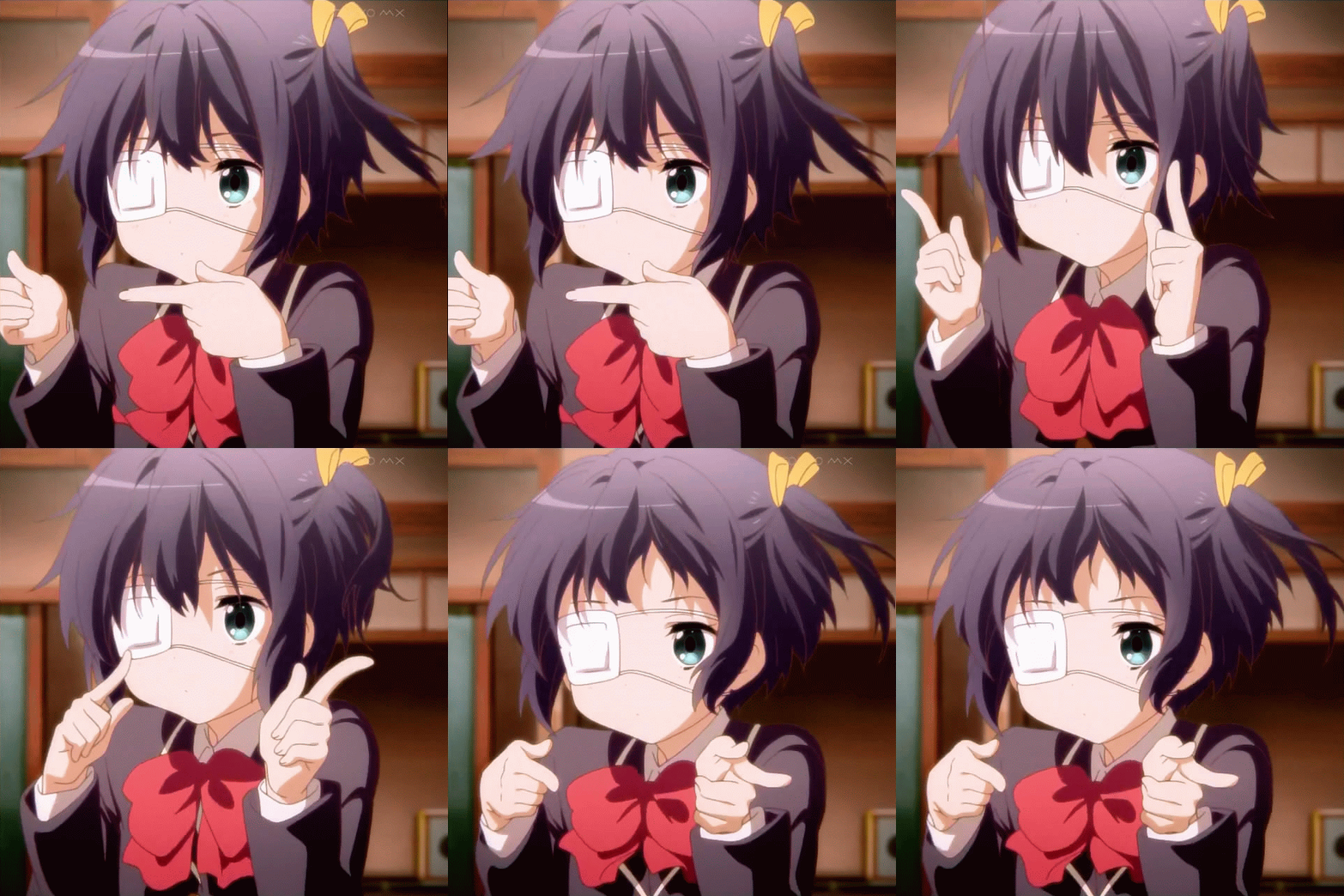
Chuunibyou demo Koi ga Shitai!
Chuunibyou demo Koi ga Shitai!: S*
This is a series for anyone who's ever done anything for absolutely no reason other than because it was cool.
This is a series for anyone who's ever tried to get away from reality by inventing a fantasy to replace it.
This is a series for anyone who's ever felt out of place, like they didn't belong among the rest of the world.
This is a series for pretty much everybody.
* While Chuu2Koi gets the S rank for being extremely thought-provoking, very intelligent, heartstoppingly gorgeous and a genuinely deep story about being human, the final episode falls short of the series' potential. It resolves the story itself, but fails to come to any true conclusion regarding the questions it raises, probably because they are extremely personal to everyone who engages with them. The ending's weakness reduces the final impact of the series, but doesn't prevent it from still being eye-opening on a level few anime series manage, so it still gets the S rank from me despite being considerably less perfect than most series I rank as S.
This is a series for anyone who's ever done anything for absolutely no reason other than because it was cool.
This is a series for anyone who's ever tried to get away from reality by inventing a fantasy to replace it.
This is a series for anyone who's ever felt out of place, like they didn't belong among the rest of the world.
This is a series for pretty much everybody.
* While Chuu2Koi gets the S rank for being extremely thought-provoking, very intelligent, heartstoppingly gorgeous and a genuinely deep story about being human, the final episode falls short of the series' potential. It resolves the story itself, but fails to come to any true conclusion regarding the questions it raises, probably because they are extremely personal to everyone who engages with them. The ending's weakness reduces the final impact of the series, but doesn't prevent it from still being eye-opening on a level few anime series manage, so it still gets the S rank from me despite being considerably less perfect than most series I rank as S.
Sunday, December 9, 2012
Kanon (2006)
Kanon (2006): A
It takes a lot for me to give a Visual Novel adaptation an A. Kanon earns it. The name comes from the Katakana reading of 'Canon,' the name for a piece of music which takes a central theme and repeats it with slight changes, an idea which the anime explores, once you look between the lines. Just one example of the way in which Kanon is a very intelligent series, hiding behind its girl-game exterior.
Kanon is a story about love, memory and miracles. It is a story about loss, fear and depression. It is a story with a lot of drama and a lot of suffering. The thing I love most about it is its humor: Yuuichi (on the right, above) voiced by Tomokazu Sugita (best known as Kyon from Haruhi Suzumiya) being snarky and teasingly friendly with the girls of the cast. Yuuichi also stands out for me as being a very characterful protagonist, he gets awkward around the girl he likes, forgets his promises and makes fun of his friends even as he struggles to do the right thing, rather than providing the weird sense of 'boys must protect girls to get laid' that so many harem series do.
Kanon's adaptation from a Visual Novel is one of the best I've seen, though it also is very clear how they chose to handle the multi-arc presentation: after the cast is introduced, a 3-5 episode arc is dedicated to each of the Visual novel's original storylines, and Kanon manages to thread them all together quite nicely, far better than Air, Utawarerumono or Fate Stay Night; Kanon's overall story is coherent and builds on itself nicely.
Kanon is, like most Key adaptations, quite sad. I cried. Not as much as I cried at Ano Hana, but I did cry. It's genuinely heartwrenching in places, but somehow manages to have an uplifting ending, and not one of those endings that's actually depressing but I personally find uplifting, either.
I hesitate to call it a 'harem' series, because while there are are a high number of female characters, and even female characters with crushes on the protagonist, the crushes are not the focuses of the story and are treated with a certain amount of gravity. Which isn't to say that I couldn't criticize the series at all, but I find myself not needing to because it handles itself with such grace.
If you want to watch a gorgeously animated series with plenty of sorrow, growth and heartstring-tugging, Kanon is a lovely tale of hope in the middle of winter. If you're looking for something funny... Kanon delivers there too. If you need action... actually Kanon has a bit of that, but not a lot. Really what I'm saying is that Kanon is very, very good.
It takes a lot for me to give a Visual Novel adaptation an A. Kanon earns it. The name comes from the Katakana reading of 'Canon,' the name for a piece of music which takes a central theme and repeats it with slight changes, an idea which the anime explores, once you look between the lines. Just one example of the way in which Kanon is a very intelligent series, hiding behind its girl-game exterior.
Kanon is a story about love, memory and miracles. It is a story about loss, fear and depression. It is a story with a lot of drama and a lot of suffering. The thing I love most about it is its humor: Yuuichi (on the right, above) voiced by Tomokazu Sugita (best known as Kyon from Haruhi Suzumiya) being snarky and teasingly friendly with the girls of the cast. Yuuichi also stands out for me as being a very characterful protagonist, he gets awkward around the girl he likes, forgets his promises and makes fun of his friends even as he struggles to do the right thing, rather than providing the weird sense of 'boys must protect girls to get laid' that so many harem series do.
Kanon's adaptation from a Visual Novel is one of the best I've seen, though it also is very clear how they chose to handle the multi-arc presentation: after the cast is introduced, a 3-5 episode arc is dedicated to each of the Visual novel's original storylines, and Kanon manages to thread them all together quite nicely, far better than Air, Utawarerumono or Fate Stay Night; Kanon's overall story is coherent and builds on itself nicely.
Kanon is, like most Key adaptations, quite sad. I cried. Not as much as I cried at Ano Hana, but I did cry. It's genuinely heartwrenching in places, but somehow manages to have an uplifting ending, and not one of those endings that's actually depressing but I personally find uplifting, either.
I hesitate to call it a 'harem' series, because while there are are a high number of female characters, and even female characters with crushes on the protagonist, the crushes are not the focuses of the story and are treated with a certain amount of gravity. Which isn't to say that I couldn't criticize the series at all, but I find myself not needing to because it handles itself with such grace.
If you want to watch a gorgeously animated series with plenty of sorrow, growth and heartstring-tugging, Kanon is a lovely tale of hope in the middle of winter. If you're looking for something funny... Kanon delivers there too. If you need action... actually Kanon has a bit of that, but not a lot. Really what I'm saying is that Kanon is very, very good.
Thursday, November 8, 2012
Shoujo Kakumei Utena
Shoujo Kakumei Utena: A
Revolutionary Girl Utena is something of a famous anime, if you grew up on anime from the late 90s and early 2000s, because you couldn't get it all legally, the license was bought and then sat on, so the only way to watch the series was on bootlegs, which circulated around my high school during my junior and senior years, so I've got a long history with this show.
I was not expecting to give it an A this watch-through. I was thinking "eh, I think it'll only make B+ this time," and "I bet it won't hold up against its younger brother Star Driver." But, to my modest frustration, it does, and I end my watching going "Well dammit, I guess I'm giving it an A."
Utena is a lot of things, as a show, but the number one thing that it is is open to interpretation. More than almost any other show I've ever seen, everyone who sees Utena walks away with a different idea of what happened and what meant what. I only watch the series every five years or so, and I've come up with different interpretations each time. And each time, those interpretations have involved me so much that I can't put the series down, especially toward the end.
Utena may also be the single most twisted show toward its characters I am aware of; there are shows that are dirtier, bleaker, more depressing, have a higher body count and a greater degree of active sadism, but I can think of no other anime series that is so personally and deliberately hurtful to its characters. It's one of the things I love.
My criticisms of Utena mostly come in the early series, and a few stick throughout. Utena is fairly heavy on clip shows and filler, and while these are both done in ways which are entertaining, in a series that is so heavily built on mystery and symbolism, you get episodes where you just go 'gaaah, give me some goddamn plot!' Secondly, Utena feels like it leaves too much to the imagination, I've often said in describing the series that the series is definitely 30% symbolism and 30% absurdity, but I have no idea where the other 40% falls on that scale. There is no way to create a theory to correlate with everything that occurs, and the series does not bother explaining itself. Finally, and this is a minor thing, Utena doesn't reverse telegraph its secrets. Watching the series when you know what's going on doesn't cause you to go 'Hey, there's the abusive relationship that I know about that but haven't seen much of.' Utena doesn't tip its hand, so you only learn secrets as they are revealed. It's a minor thing, but I like the other way.
All that said, Utena is a fantastic story about friendship, lust, growing up, idealism, wishes, truth, hatred, dependence and defiance of self, of society and of rejection. Don't let its stylized art and shoujo nature fool you, this is a story that has plenty to offer the grown-up audience... if you have the patience to unravel it.
Revolutionary Girl Utena is something of a famous anime, if you grew up on anime from the late 90s and early 2000s, because you couldn't get it all legally, the license was bought and then sat on, so the only way to watch the series was on bootlegs, which circulated around my high school during my junior and senior years, so I've got a long history with this show.
I was not expecting to give it an A this watch-through. I was thinking "eh, I think it'll only make B+ this time," and "I bet it won't hold up against its younger brother Star Driver." But, to my modest frustration, it does, and I end my watching going "Well dammit, I guess I'm giving it an A."
Utena is a lot of things, as a show, but the number one thing that it is is open to interpretation. More than almost any other show I've ever seen, everyone who sees Utena walks away with a different idea of what happened and what meant what. I only watch the series every five years or so, and I've come up with different interpretations each time. And each time, those interpretations have involved me so much that I can't put the series down, especially toward the end.
Utena may also be the single most twisted show toward its characters I am aware of; there are shows that are dirtier, bleaker, more depressing, have a higher body count and a greater degree of active sadism, but I can think of no other anime series that is so personally and deliberately hurtful to its characters. It's one of the things I love.
My criticisms of Utena mostly come in the early series, and a few stick throughout. Utena is fairly heavy on clip shows and filler, and while these are both done in ways which are entertaining, in a series that is so heavily built on mystery and symbolism, you get episodes where you just go 'gaaah, give me some goddamn plot!' Secondly, Utena feels like it leaves too much to the imagination, I've often said in describing the series that the series is definitely 30% symbolism and 30% absurdity, but I have no idea where the other 40% falls on that scale. There is no way to create a theory to correlate with everything that occurs, and the series does not bother explaining itself. Finally, and this is a minor thing, Utena doesn't reverse telegraph its secrets. Watching the series when you know what's going on doesn't cause you to go 'Hey, there's the abusive relationship that I know about that but haven't seen much of.' Utena doesn't tip its hand, so you only learn secrets as they are revealed. It's a minor thing, but I like the other way.
All that said, Utena is a fantastic story about friendship, lust, growing up, idealism, wishes, truth, hatred, dependence and defiance of self, of society and of rejection. Don't let its stylized art and shoujo nature fool you, this is a story that has plenty to offer the grown-up audience... if you have the patience to unravel it.
Thursday, November 1, 2012
Hyouka
Hyouka: A+
"Hyouka" means "Frozen Treats," when translated literally. "Ice Cream" would probably be a better way of saying it.
If you want to know why this series is called that, you'll have to watch the first five or six episodes. That's one of the first mysteries the Classics Club solves.
Hyouka is a calm, slow-paced and dialogue-heavy high school mystery series that follows the Classics club at Kamiyama High School, four students who gain a reputation in the school for solving real, little mysteries: the first episode's first mystery is why the club room door was unlocked when one member arrived, but locked, requiring a key, when the second arrived.
The series is noteworthy for Kyoto Animation's heartbreakingly beautiful animation, complex, deep and thoughtful characterization of a very small cast who we have plenty of time to get to know and come to befriend, its relative lack of common anime tropes and the cultural depth of the 'old family' characters.
If you want to watch a series that is beautiful, intelligent, thoughtful and patient, Hyouka is a wonderful, gentle ride through the kind of mysteries that puzzle people. If you're interested in action, comedy or even anything particularly magical beyond maybe the birth of love, Hyouka will probably leave you a little bit bored.
"Hyouka" means "Frozen Treats," when translated literally. "Ice Cream" would probably be a better way of saying it.
If you want to know why this series is called that, you'll have to watch the first five or six episodes. That's one of the first mysteries the Classics Club solves.
Hyouka is a calm, slow-paced and dialogue-heavy high school mystery series that follows the Classics club at Kamiyama High School, four students who gain a reputation in the school for solving real, little mysteries: the first episode's first mystery is why the club room door was unlocked when one member arrived, but locked, requiring a key, when the second arrived.
The series is noteworthy for Kyoto Animation's heartbreakingly beautiful animation, complex, deep and thoughtful characterization of a very small cast who we have plenty of time to get to know and come to befriend, its relative lack of common anime tropes and the cultural depth of the 'old family' characters.
If you want to watch a series that is beautiful, intelligent, thoughtful and patient, Hyouka is a wonderful, gentle ride through the kind of mysteries that puzzle people. If you're interested in action, comedy or even anything particularly magical beyond maybe the birth of love, Hyouka will probably leave you a little bit bored.
Friday, October 12, 2012
Denpa Onna to Seishun Otoko
Denpa Onna to Seishun Otoko: A
The title translates to "The Radio Wave Girl and the Adolescent Boy." There are a number of other ways to translate "Radio Wave" and "Adolescent," as both are used as kind of symbolic terms, but this way makes as much sense as any.
Yet another show directed by Akiyuki Shinbo, but lacking a lot of his trademark audiovisual weirdness. And yet, I find, it's still breathtaking to watch and its animation is of the highest caliber.
Dotso (as it abbreviates to) starts out slowly, with our Adolescent Boy, obsessed with cataloging how successfully he is living his young life to the fullest, moving to the city to live with his aunt while his parents work abroad. From there, he meets our Radio Wave girl, his cousin, an extreme hikkikomori (one who hides from society) who claims to be an alien and wanders around with a futon wrapped around her.
What begins looking like it might be a Haruhi Suzumiya-esque manic pixie dream girl scenario evolves into a story about perseverance, recovering from one's mistakes and the self-imposed hurdle of impossibility, put non-invasively into the context of a fairly non-invasive harem. The cast remains very small (the main cast is only 6 characters), and while a lot of threads (the romantic aspect and Erio's re-integration into society) are left dangling at the end of the series, the story nevertheless has an ending.
Also, contrary to a lot of other series that I've found myself really liking, Dotso isn't nearly as mean to its characters: the trauma is fairly minor and doesn't happen on screen, no cathartic scenes of screaming or crying or rage. Which isn't to say that the characters aren't realistic (Ryuushi's jealousy is some of the most honest jealousy I've ever seen), just that the situation doesn't warrant quite the same level of suffering as say, Madoka, Evangelion or Ano Hana.
Don't watch this show if you don't want to have to remember long titles in Japanese, or if you're more interested in action and physical conflict. But if you like stories about people growing, pushing forward and being rewarded for trying to do something they thought they couldn't do, you'll find Denpa Onna to Seishun Otoko to be quietly inspiring.
The title translates to "The Radio Wave Girl and the Adolescent Boy." There are a number of other ways to translate "Radio Wave" and "Adolescent," as both are used as kind of symbolic terms, but this way makes as much sense as any.
Yet another show directed by Akiyuki Shinbo, but lacking a lot of his trademark audiovisual weirdness. And yet, I find, it's still breathtaking to watch and its animation is of the highest caliber.
Dotso (as it abbreviates to) starts out slowly, with our Adolescent Boy, obsessed with cataloging how successfully he is living his young life to the fullest, moving to the city to live with his aunt while his parents work abroad. From there, he meets our Radio Wave girl, his cousin, an extreme hikkikomori (one who hides from society) who claims to be an alien and wanders around with a futon wrapped around her.
What begins looking like it might be a Haruhi Suzumiya-esque manic pixie dream girl scenario evolves into a story about perseverance, recovering from one's mistakes and the self-imposed hurdle of impossibility, put non-invasively into the context of a fairly non-invasive harem. The cast remains very small (the main cast is only 6 characters), and while a lot of threads (the romantic aspect and Erio's re-integration into society) are left dangling at the end of the series, the story nevertheless has an ending.
Also, contrary to a lot of other series that I've found myself really liking, Dotso isn't nearly as mean to its characters: the trauma is fairly minor and doesn't happen on screen, no cathartic scenes of screaming or crying or rage. Which isn't to say that the characters aren't realistic (Ryuushi's jealousy is some of the most honest jealousy I've ever seen), just that the situation doesn't warrant quite the same level of suffering as say, Madoka, Evangelion or Ano Hana.
Don't watch this show if you don't want to have to remember long titles in Japanese, or if you're more interested in action and physical conflict. But if you like stories about people growing, pushing forward and being rewarded for trying to do something they thought they couldn't do, you'll find Denpa Onna to Seishun Otoko to be quietly inspiring.
Thursday, October 4, 2012
Neon Genesis Evangelion
Neon Genesis Evangelion: S
So, Evangelion was for me what Harry Potter was for a lot of kids who are slightly younger than me. It was formative. I saw it when I was 14, in 1998, and it was one of the first anime series I ever saw. I was at a point in my life where I was searching for meaning, for motivation, for purpose, and I found it through the suffering and growth of another 14-year old, the boy named Shinji Ikari.
I could give a summary of Eva, or reasons to watch it, but everything I could say on those topics has already been said elsewhere on the internet. It's too popular, too embedded in the anime-viewers' collective consciousness, even the ones who have never seen it, because of the effect it had on anime as a medium: Evangelion is almost certainly the single most influential series of all time.
For me, the thing I want to talk about is how difficult it seems to be for viewers to allow themselves to be affected by the emotional content of the story. Eva is a series where practically all of the characters are varying degrees of unlikeable: Shinji is a passive, self-denying doormat, Rei is incapable of coherent self-expression, Asuka is an egocentric showboat, Misato is self-deceptive hypocrite, Ritsuko is a liar of outstanding proportions and Gendo is utterly lacking in compassion. However, the power of the series comes from the viewer's ability to sympathize with these characters despite their flaws, indeed, to recognize these flaws as being human and reflected in themselves: These people are like you, and who they are brings them pain, just like you.
I cannot count the number of times I have heard the series referred to or discussed in terms which ignore its emotional content, instead making jokes about the screen going red and Shinji screaming, dialogueless scenes, frame saving, incomprehensible philosophical pontification, or sexual subtext (or just plain text, in a few cases). Joking about it allows the viewer to evade sympathy by treating the content as absurd or engaging in schadenfreude at the characters' expense, and that denies the emotional impact which is the core of the series' purpose.
Much like it's younger, more upbeat cousin Gurren Lagann, if Eva doesn't affect you emotionally, you're missing what the series is about. Not everyone is interested in being affected in the violently cathartic way that Eva attempts to affect you, though, and this is probably the real reason that there are so many jokes at the series' expense: when you're watchin' anime with your friends, you don't want to have your emotional walls torn down and your mortality and purpose in life brought into question, you just want to watch the explosions and the boobs.
This is a reason why I have strongly recommended that the series be watched alone, because when viewed in a group, people are far more likely to try to appear knowledgeable, clever, or funny at the cost of sympathy and connection, without which, Eva becomes what it is most often described as: weirdly-used christian iconography peppered with sparse dialogue, technobabble and scenes of crying, screaming and giant robots fighting giant monsters (often at the same time).
But for me, and many others, that was not what Neon Genesis Evangelion was about, that was simply the context in which an empowering story about personal responsibility, identity, choice and love could occur.
So, Evangelion was for me what Harry Potter was for a lot of kids who are slightly younger than me. It was formative. I saw it when I was 14, in 1998, and it was one of the first anime series I ever saw. I was at a point in my life where I was searching for meaning, for motivation, for purpose, and I found it through the suffering and growth of another 14-year old, the boy named Shinji Ikari.
I could give a summary of Eva, or reasons to watch it, but everything I could say on those topics has already been said elsewhere on the internet. It's too popular, too embedded in the anime-viewers' collective consciousness, even the ones who have never seen it, because of the effect it had on anime as a medium: Evangelion is almost certainly the single most influential series of all time.
For me, the thing I want to talk about is how difficult it seems to be for viewers to allow themselves to be affected by the emotional content of the story. Eva is a series where practically all of the characters are varying degrees of unlikeable: Shinji is a passive, self-denying doormat, Rei is incapable of coherent self-expression, Asuka is an egocentric showboat, Misato is self-deceptive hypocrite, Ritsuko is a liar of outstanding proportions and Gendo is utterly lacking in compassion. However, the power of the series comes from the viewer's ability to sympathize with these characters despite their flaws, indeed, to recognize these flaws as being human and reflected in themselves: These people are like you, and who they are brings them pain, just like you.
I cannot count the number of times I have heard the series referred to or discussed in terms which ignore its emotional content, instead making jokes about the screen going red and Shinji screaming, dialogueless scenes, frame saving, incomprehensible philosophical pontification, or sexual subtext (or just plain text, in a few cases). Joking about it allows the viewer to evade sympathy by treating the content as absurd or engaging in schadenfreude at the characters' expense, and that denies the emotional impact which is the core of the series' purpose.
Much like it's younger, more upbeat cousin Gurren Lagann, if Eva doesn't affect you emotionally, you're missing what the series is about. Not everyone is interested in being affected in the violently cathartic way that Eva attempts to affect you, though, and this is probably the real reason that there are so many jokes at the series' expense: when you're watchin' anime with your friends, you don't want to have your emotional walls torn down and your mortality and purpose in life brought into question, you just want to watch the explosions and the boobs.
This is a reason why I have strongly recommended that the series be watched alone, because when viewed in a group, people are far more likely to try to appear knowledgeable, clever, or funny at the cost of sympathy and connection, without which, Eva becomes what it is most often described as: weirdly-used christian iconography peppered with sparse dialogue, technobabble and scenes of crying, screaming and giant robots fighting giant monsters (often at the same time).
But for me, and many others, that was not what Neon Genesis Evangelion was about, that was simply the context in which an empowering story about personal responsibility, identity, choice and love could occur.
Sunday, June 24, 2012
Bakemonogatari and Nisemonogatari
Bakemonogatari: AA++
Nisemonogatari: A
So first let me say that Bakemonogatari is pretty much my favorite series of all time, right now. Nisemonogatari is the 'sequel' series, and aired earlier this year. There's going to be a prequel, a movie, called Kizumonogatari released later this year.
The titles are all portmanteaus of the world 'monogatari' which means 'story.' 'Bakemono' means ghost or monster, Nisemono means a fake or an imposter, and Kizumono means 'damaged goods'. If I had to anglicize them, "GhoStory" and "ImpoStory" come fairly easily, though I don't know what to do with Kizumonogatari.
Like most series which I recommend highly, my primary way of recommending Bakemonogatari is to just say "Watch it."
However, Bakemonogatari isn't an S rank, for very specific reasons: it's extraordinarily dialogue-heavy, it's rather perverted, it revolves deeply around japanese mythology, language and symbolism, it's much darker than it looks on the surface and to really get everything out of it it requires a thorough analysis of actions vs words: most of the characters lie or are mistaken, and it is only occasionally pointed out directly that they were lying or wrong in retrospect, it is simply shown that they were wrong or inaccurate.
This makes it the kind of series that you have to let yourself get involved in to fully appreciate. However, the characters are flavorful, the art is absolutely stunning and the writing is clever, it's not difficult to get yourself wrapped up in it.
In short, if you're like me, you'll absolutely adore this series.
Nisemonogatari is overall weaker than the original series, I feel, but is still very good, as it expands inter-character relationships as well as providing substantial character development and further explaining certain characters' history and even more quiet, disturbing implications.
Nisemonogatari: A
So first let me say that Bakemonogatari is pretty much my favorite series of all time, right now. Nisemonogatari is the 'sequel' series, and aired earlier this year. There's going to be a prequel, a movie, called Kizumonogatari released later this year.
The titles are all portmanteaus of the world 'monogatari' which means 'story.' 'Bakemono' means ghost or monster, Nisemono means a fake or an imposter, and Kizumono means 'damaged goods'. If I had to anglicize them, "GhoStory" and "ImpoStory" come fairly easily, though I don't know what to do with Kizumonogatari.
Like most series which I recommend highly, my primary way of recommending Bakemonogatari is to just say "Watch it."
However, Bakemonogatari isn't an S rank, for very specific reasons: it's extraordinarily dialogue-heavy, it's rather perverted, it revolves deeply around japanese mythology, language and symbolism, it's much darker than it looks on the surface and to really get everything out of it it requires a thorough analysis of actions vs words: most of the characters lie or are mistaken, and it is only occasionally pointed out directly that they were lying or wrong in retrospect, it is simply shown that they were wrong or inaccurate.
This makes it the kind of series that you have to let yourself get involved in to fully appreciate. However, the characters are flavorful, the art is absolutely stunning and the writing is clever, it's not difficult to get yourself wrapped up in it.
In short, if you're like me, you'll absolutely adore this series.
Nisemonogatari is overall weaker than the original series, I feel, but is still very good, as it expands inter-character relationships as well as providing substantial character development and further explaining certain characters' history and even more quiet, disturbing implications.
Subscribe to:
Posts (Atom)