Showing posts with label KyoAni. Show all posts

Thursday, April 24, 2014

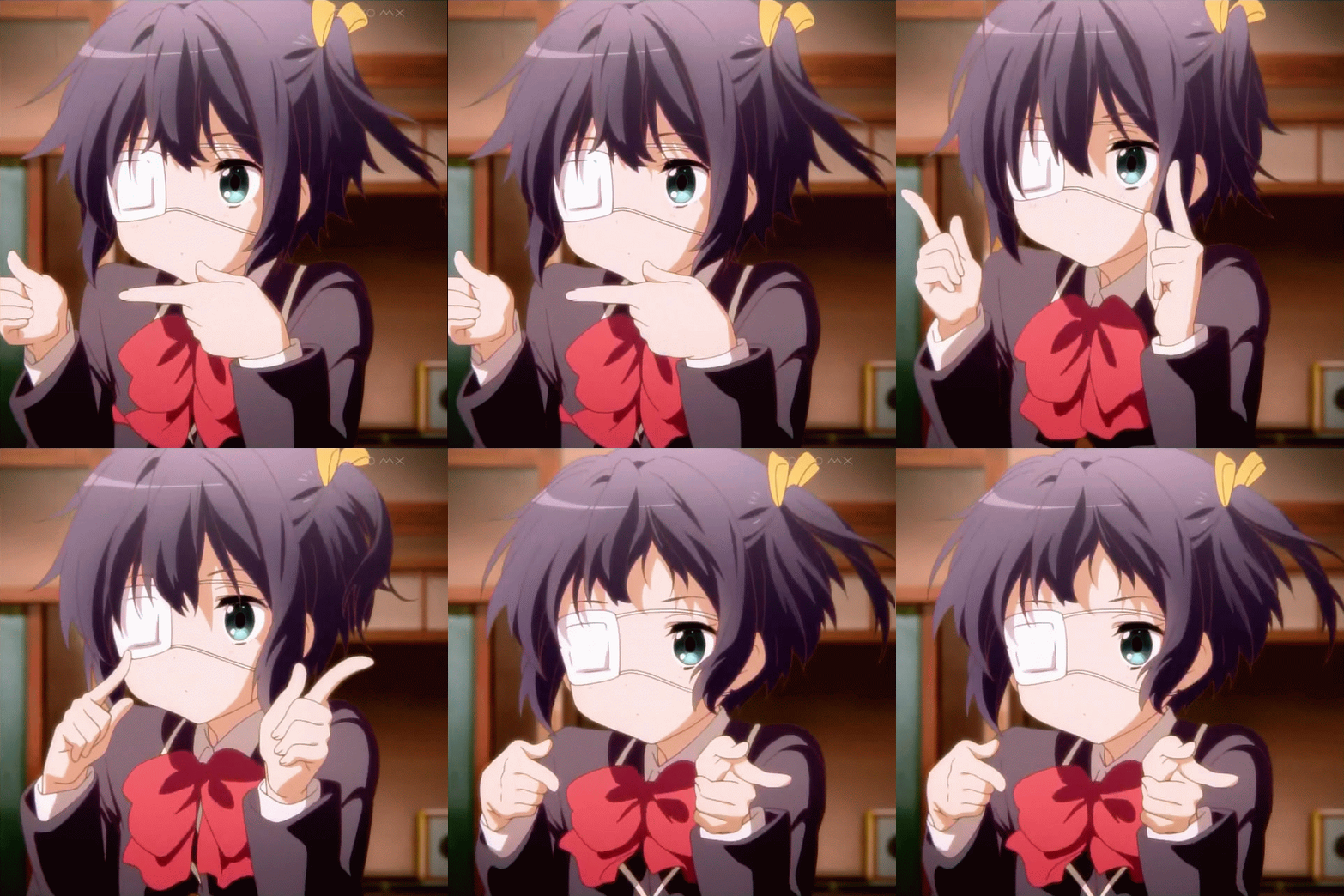
Chuunibyou Demo Koi ga Shitai! Ren

Chuunibyou Demo Koi ga Shitai! Ren:  B+


So I heard Chuunibyou, my most recent series to get an S grade, was getting a second season midway through last year.  And I dreaded it a little bit.  The first season had a good arc, told a good story.  Did it need more?  I didn't think so.

And really, I still don't think it needed more, but so long as it's getting more, what it got was actually pretty good.

We get a single new character who is actually handled pretty well and becomes extremely sympathetic.  We get more adorable and hilarious eighth-grader syndrome hijinks.  We get some poorly written episodes that fail to commit.  We get some very well-written episodes that don't fail to commit.  For all that it's spurious and lacks the depth and power of the first season, Ren is definitely not bad and there was a little part of me that wanted to give it an A, but it just falls into a few too many traps.

I'm generally anti-sequel, so this is actually a pretty positive review.  If you liked the first season, the second season has more of the good things that the first had: comedy, eye-melting imaginary action scenes, awkward romance, emotional turmoil, embarrassing deliberate melodrama.  If you didn't like the first season, a) what is wrong with you it was really good and b) the second season doesn't change the formula much, though it is definitely about slightly different things, like building on a relationship, unrequited love and what friendship is about.  Definitely doesn't make the first season better through it's existence but it also doesn't retroactively weaken it.

Saturday, December 21, 2013

Kyoukai no Kanata

Kyoukai no Kanata:  B

This image doubles as a useful 'shut up and take my money' image macro.

So, series for this season are ending and that means I have opinions about them and I write them here.  This particular series is Kyoto Animation's offering for this season.

Unlike practically everything else Kyoto Animation has done in recent memory, it's a series with a lot of supernatural elements and a lot of action.  The cute girl above is actually a demon exterminator who uses her blood as a weapon (thus the bandages on her hand), and several of the other characters are as well, in addition to a number of demon characters (the japanese word being used is 'youmu', which doesn't translate particularly well into english, they're creatures made from the negative emotions of humanity, though they don't seem to be intrinsically evil).

And not to spoil anything, but the male protagonist is an immortal half-demon.  Kyoukai no Kanata (which translates as "Beyond the Boundary") earned points with me early on for, despite him being an immortal half-demon, he is demonstrably not a badass, he's pretty much just a dude with a thing for girls in glasses.  Except it turns out there's a bit more to it than that and his circle of friends is a bit more messed up than that.  And all in all, it's pretty good.  The ending is competent and doesn't bother explaining itself, but whatever, it's at least an ending.

Also there's a random basically OVA-style heavy fan service episode in the middle of the series, but it doesn't ruin anything it's just kind of weird and acontextual.

Kyoukai no Kanata is beautifully animated, but its writing is merely competent.  It's not genius, though it's is fun to watch.  I don't have a lot bad to say about it other than that it's just not amazing.  If you want some good supernatural romance comedy drama action, go ahead and watch Kyoukai no Kanata.  Really, the only people I wouldn't recommend it to are people who dislike anime tropes, because they're pretty present, but if you don't like anime, why are you reading my opinions on it?

Monday, November 11, 2013

Lucky Star

Lucky Star: B


Really hard to give a rating to this show, since it's about nothing.  Lucky Star is a slice of life show by Kyoto Animation with a number of notable qualities: it was one of the first major discussions of otaku culture that gained significant popularity in the west, the art style is highly recognizable and the series was wildly successful.  Personally, it was the series that taught me the words 'moe', 'lolicon' and 'fujoshi', as well as introducing me to tsurime.  It still remains the only series I have seen with a character who is an American otaku.  If you're familiar with the 'X is mai waifu' meme, Lucky Star fans originated that during the show's first airing, proclaiming otaku loli Konata to be their waifu.

But really, it's about nothing.  The characters talk about whatever's on their minds.  Though doing so they reveal quite a bit about their personalities and what they think various things and each other, and that's kind of fun.  But there is no drama, no plot, no progress and no development.  If it weren't so deliberate I would criticize this, as it is it's more a factor that prevents the series from being 'genius' and leaves it as simply 'entertaining'.  It features dozens upon dozens of references to other anime, most especially the Haruhi Suzumiya series, which it aired shortly after, and shares a number of voice actors with (not to mention being made by the same studio).

Lucky Star is the sort of show that so long as you know what to expect (and are interested in that) you'll probably enjoy.  The writing is clever, the characters are entertaining and even a westerner will have a lot of moments of thinking 'yeah, that totally happens, heh'.  If the idea of just watching girls talking about whatever doesn't appeal to you then you shouldn't watch it.

Saturday, September 28, 2013

Free!

Free!:  B+

Kyoto Animation doing their thing, only this time rather than adorable girls we have lovingly animated young men swimming.  You will rarely see so many muscles animated quite this realistically, and Kyoto Animation's stunning animation is in full force.  They also clearly wanted practice drawing a lot of water.

The story itself doesn't slouch either.  While it isn't truly inspired, it is a solid story about motivation, competition, teamwork and loving what you do, I was actually surprised at how well it comes together.

I feel like I should say more about the series, but there really isn't a lot more to say.  It's gorgeous, full of tasteful manservice, but a good, heartful story about sports, in the way where you don't have to love sports to get into it.

Oh, I guess I could talk about the yaoi.  Which isn't really there.  I mean, you don't really have to stretch to say that there's homoerotic undertones, but it feels unfair to the actual good story there to say that it's a major element.

If you want to watch a show with either a lot of really well-drawn muscular young men or a good story that'll make you want to go for a swim sometime, Free! is a good watch.  It is thoroughly grounded in realism and all the tension is emotional, so you won't get much out of it if you're interested in magic or sci-fi or explosions.

Friday, March 29, 2013

Tamako Market

Tamako Market: C

Kyoto Animation's offering for this season.  The story of a girl whose family runs a mochi shop in a small-town shopping arcade, and her visitation by a talking bird from a foreign land, searching for his prince's bride.

It continues KyoAni's standards of amazing animation, but also, unfortunately, their traditions of harmlessness and being non-threatening.  Tamako Market is a rather extreme example in this, and is probably the most harmless and least risky series they've ever done.  It's absolutely adorable and very sweet, but, like cotton candy, it lacks substance and is, perhaps too sweet at times.

Every episode has a pithy moral to it, but they are not particularly well-executed or demonstrated, though they are quite heartful.  Overall the series simply lacks punch.

If you need a calm, pretty, sweet little story to cleanse your brain of anything but cuteness, Tamako Market has you covered.  If you're looking for substance, action, drama, emotion or even conflict, there really isn't any here.

Saturday, March 16, 2013

Clannad & Clannad After Story

Clannad: A
Clannad After Story: B+


The third of Key Visual Arts's Visual-Novels-Turned-Anime made by Kyoto Animation, Clannad has the distinction of being the only one to have never been an eroge (hentai game).

Having watched it, I can see the pattern of what Key is doing with their stories emerging more clearly.  Each time they pick a theme and create a number of stories within it, using each of the character paths to explore this theme in various ways.  Air explored suffering, Kanon explored memory.  Clannad explores family; After Story continues this exploration from 'finding a family' to 'building a family'.

This series is heartwrenching and emotional in a way that's difficult to convey in words: the exploration of the characters as a family results in extremely deep and powerful relationships and watching those relationships grow and change is extremely moving.  After Story follows characters considerably further than most romances, we see our characters not only finally get together, but also grow into adults, get married and even have children, accompanied by challenges, hauntings from the past and normal, human tribulations.

Clannad is much more coherent than Air, and has many of the things I liked about Kanon, though I consider Kanon to be better overall, and a far better Visual Novel adaptation than Clannad, due to the ending of the final episodes of After Story.  After Story, as a Visual Novel (and like many Visual Novels) has both a "Standard End" and a "True End."  After Story's Standard End is actually quite heartbreaking, and so the anime also provides the True End, but since they are separate timelines, they had to find a way to make both somehow happen, and the way they do so (not that I can come up with a better one) makes the emotional consequence of the Standard End (which I personally found to be some of the most moving and deep in the entire series) feel cheapened.  This, plus the thinning of the cast as most of the high school gang goes out to live their own lives, leads to After Story's lower rating, despite the fact that I will also say that After Story's high points are higher than the first series', and its emotional payoff is bigger.

Clannad is, in the end: cute, funny, sweet, thought-provoking and extraordinarily emotional.  Anyone who can stand a calmly-paced but heavy story that explores a theme of 'family,' in all its varying definitions will probably like Clannad.  If you need action, suspense, violence or anything more unbelievable than a few small miracles, the series will put you to sleep.

Thursday, December 20, 2012

Chuunibyou demo Koi ga Shitai!

Chuunibyou demo Koi ga Shitai!:  S*

This is a series for anyone who's ever done anything for absolutely no reason other than because it was cool.

This is a series for anyone who's ever tried to get away from reality by inventing a fantasy to replace it.

This is a series for anyone who's ever felt out of place, like they didn't belong among the rest of the world.

This is a series for pretty much everybody.

* While Chuu2Koi gets the S rank for being extremely thought-provoking, very intelligent, heartstoppingly gorgeous and a genuinely deep story about being human, the final episode falls short of the series' potential.  It resolves the story itself, but fails to come to any true conclusion regarding the questions it raises, probably because they are extremely personal to everyone who engages with them.  The ending's weakness reduces the final impact of the series, but doesn't prevent it from still being eye-opening on a level few anime series manage, so it still gets the S rank from me despite being considerably less perfect than most series I rank as S.

Sunday, December 9, 2012

Kanon (2006)

Kanon (2006): A


It takes a lot for me to give a Visual Novel adaptation an A.  Kanon earns it.  The name comes from the Katakana reading of 'Canon,' the name for a piece of music which takes a central theme and repeats it with slight changes, an idea which the anime explores, once you look between the lines.  Just one example of the way in which Kanon is a very intelligent series, hiding behind its girl-game exterior.

Kanon is a story about love, memory and miracles.  It is a story about loss, fear and depression.  It is a story with a lot of drama and a lot of suffering.  The thing I love most about it is its humor: Yuuichi (on the right, above) voiced by Tomokazu Sugita (best known as Kyon from Haruhi Suzumiya) being snarky and teasingly friendly with the girls of the cast.  Yuuichi also stands out for me as being a very characterful protagonist, he gets awkward around the girl he likes, forgets his promises and makes fun of his friends even as he struggles to do the right thing, rather than providing the weird sense of 'boys must protect girls to get laid' that so many harem series do.

Kanon's adaptation from a Visual Novel is one of the best I've seen, though it also is very clear how they chose to handle the multi-arc presentation: after the cast is introduced, a 3-5 episode arc is dedicated to each of the Visual novel's original storylines, and Kanon manages to thread them all together quite nicely, far better than Air, Utawarerumono or Fate Stay Night; Kanon's overall story is coherent and builds on itself nicely.

Kanon is, like most Key adaptations, quite sad.  I cried.  Not as much as I cried at Ano Hana, but I did cry.  It's genuinely heartwrenching in places, but somehow manages to have an uplifting ending, and not one of those endings that's actually depressing but I personally find uplifting, either.

I hesitate to call it a 'harem' series, because while there are are a high number of female characters, and even female characters with crushes on the protagonist, the crushes are not the focuses of the story and are treated with a certain amount of gravity.  Which isn't to say that I couldn't criticize the series at all, but I find myself not needing to because it handles itself with such grace.

If you want to watch a gorgeously animated series with plenty of sorrow, growth and heartstring-tugging, Kanon is a lovely tale of hope in the middle of winter.  If you're looking for something funny... Kanon delivers there too.  If you need action... actually Kanon has a bit of that, but not a lot.  Really what I'm saying is that Kanon is very, very good.

Air

Air:  C

Air was originally a visual novel by Key Visual Arts, a hentai game in probably the least pure sense of the word, a 20+ hour story in which there are a handful of sex scenes that don't contribute much to the story.  The anime adaptation was made by Kyoto Animation, and so, since I've decided to watch everything KyoAni has ever done, Air was early on my list (since I don't want to watch all of Full Metal Panic right now, with some of it being done by not-KyoAni).

While I hadn't seen it before, I had heard of Key's work being heartbreakingly depressing, and it does hold up on that score, if you can follow the story well enough to understand why it's so depressing.  Of the original three female protagonists, two of them get rather short-changed in the story, with one having her arc resolved and one having her arc partially resolved, and both vanishing from the story after their stories are complete; yet another example of what I am now thinking of as "Fate Stay Night Syndrome" where a Visual Novel has too much material to make it into an anime.

To add to the confusion, we flash back to 10th-century Japan for a couple episodes for reasons which make sense only if you're willing to read between the lines and have been paying attention to the characters' occasional ramblings about their dreams, before returning to the present day at the beginning of the story, throwing another 'character' into the mix and going through one girl, the 'main' girl's arc again, very quickly with some minor changes and a conclusion that is somewhere between bittersweet and just plain sad.

A couple of extra episodes, "Air in Summer," are part of the flashback to ancient Japan, but while they expand on the characters from that story, they don't add much to the coherence of it.

Air is very pretty, but it comes up very short of a good story due, I assume to the translation from Visual Novel to Anime, which, in a story with multiple arcs which are theoretically based on the main character's actions and choices, are not usually well suited to transformation into a single linear story.  If you're interested in a lovingly animated, rather sad story about reincarnation, cyclical suffering and thousand-year-old curses, Air is worth a watch, but if you're hoping for a solid storyline or any sort of happy resolution, I'd recommend Kanon (see my next review) instead.

Sunday, November 18, 2012

Chuunibyou demo Koi ga Shitai! Episodes 1-7

So, I've added Kyoto Animation to my list of studios (after Shaft and Gaianx) that I will just watch everything they produce because it's gold.  Their current project is an adaptation of a two-volume Light Novel series of the title seen above.

(Man, I'm watching a lot of series these days that are just long strings of words in Japanese.  "Chuunibyou demo Koi ga Shitai!" is usually translated "In spite of my adolescent delusions of grandeur, I want a date!")

It's about a boy (Togashi Yuuta) who, before entering high school, was a delusional sort who wore a long jacket, carried a oversized fantasy resin sword, spoke in an incredibly melodramatic fashion and called himself (in Engrish) "Dark Flame Master."  However, at some point he realized how incredibly embarrassing this is and stopped doing it, trying to forget everything about it and move on, making a fresh start in high school.

Unfortunately, a girl (Takanashi Rikka) moves into the apartment above the one where he lives, and she still does stuff like that, wearing a medical eyepatch (to seal her 'Wicked Eye') and a bandage on her left arm (covering a seal on the power of the harbinger of darkness), making combat poses at everyone she meets and talking a lot about her  mana, chimera familiar (a stray cat she put wings on), the evil Priestess who shares the apartment she lives in (her big sister) and how she must be ready for battle at all times.  Due to a momentary indiscretion when Yuuta is attempting to cleanse himself of his past forever, his neighbor (also his classmate) overhears of him being Dark Flame Master, and attempts to befriend him as a dark sorcerer who is also facing the threats that she faces.

... And we've all been there?  Right?  ...Right?

Anyway, as someone who is only about 90-95% over his own adolescent delusions of grandeur (Chuunibyou literally translates as 'Eighth-grader disease'), I find the premise to be nostalgic and amusing (and that's without mentioning Kyoto Animation's eye-melting artwork), and the execution to be effective and interesting.  Rikka and Yuuta are hardly the only characters who have ever suffered from chuunibyou, and it's not portrayed as a life-destroying disease as much as a phase that may or may not have deeper roots.

A part of me wants to write an entire essay on the idea of adolescent delusions of grandeur and how they figure into society, grow and evolve and how accepted they are even in adults, but this is an anime blog.

So, instead, I'll say that Chuu2Koi (that's the official abbreviation, apparently) is pretty good, so far, and is likely to be high on my list of recommendations to my more grown-up nerd friends.  Since we all were like that, once upon a time.

Thursday, November 1, 2012

Hyouka

Hyouka:  A+

"Hyouka" means "Frozen Treats," when translated literally.  "Ice Cream" would probably be a better way of saying it.

If you want to know why this series is called that, you'll have to watch the first five or six episodes.  That's one of the first mysteries the Classics Club solves.

Hyouka is a calm, slow-paced and dialogue-heavy high school mystery series that follows the Classics club at Kamiyama High School, four students who gain a reputation in the school for solving real, little mysteries: the first episode's first mystery is why the club room door was unlocked when one member arrived, but locked, requiring a key, when the second arrived.

The series is noteworthy for Kyoto Animation's heartbreakingly beautiful animation, complex, deep and thoughtful characterization of a very small cast who we have plenty of time to get to know and come to befriend, its relative lack of common anime tropes and the cultural depth of the 'old family' characters.

If you want to watch a series that is beautiful, intelligent, thoughtful and patient, Hyouka is a wonderful, gentle ride through the kind of mysteries that puzzle people.  If you're interested in action, comedy or even anything particularly magical beyond maybe the birth of love, Hyouka will probably leave you a little bit bored.

Wednesday, January 18, 2012

Nichijou

Nichijou:  C+

It's said that our everyday lives are nothing less than a string of miracles.

Nichijou ("Everyday life" or "Normal life") is a slice of life series that I have a difficult time describing in any way other than "Azumanga Daioh by way of Gurren Lagann."  To be clearer, Azumanga Daioh is a series about Schoolgirls being schoolgirls.  Gurren Lagann is best known for hot-blooded-ness and taking things to new levels of absurdity.  Nichijou is a series about schoolgirls taking things to new levels of hot-blooded absurdity.

As I've said before it's really hard to talk about what a Slice of Life series is about, so instead I'll just list out of context things that occur or exist in Nichijou:

An 8-year-old scientist.
An extremely polite, well-mannered boy who rides to school on a goat.
Extraordinarily long gags.
A kendo practitioner who gives people shogi pieces for no adequately explained reason.
A manga called "Helvetica Standard."
A girl so tsundere that her only method of response to the boy she has a crush on is with heavy weapons.
The sport of Go-Soccer.
A boy who visits mediums and priests trying to disprove the supernatural.
A talking cat.

Nichijou revels in its own absurdity, and manages to be very funny and quite heartwarming in places.  In a lot of other places, the gags will result in "What?!" rather than laughter, and while I don't have anything against that sort of humor, when it's the greater part of the punchline, it gets a bit tired.  Note, however, that I watched the series alone; I suspect it would hold up better under a group audience.

If you're looking for truly absurd screwball comedy, Nichijou delivers.  If you're looking for... anything else at all, I'd stay away.

Wednesday, May 18, 2011

Haruhi Suzumiya

Haruhi Suzumiya (TV):  AA+

If you've stood next to anyone who knows about anime in the past five years, you've heard the name "Haruhi Suzumiya," it's one of the single most popular and hyped series of the last decade and it's treated by older anime fans with the kind of obsessive reverence that Naruto, Bleach and One Piece are given by the younger generation.

I didn't watch it until 2009, partially because I (like most people) hate hype and the pitch of the series ("There's this high school girl and she's god, and her friends need to keep her from finding out") didn't really grab me.  But eventually I gave in and sat down to watch it, expecting the worst.

I was shocked to find that it deserves the better part of the hype it gets.  Not only is the animation and voice acting absolutely stunning, but it is extremely well-written, the story is detailed, brilliantly designed and highly rewarding of multiple watchings.

I specifically say the story is well written rather than the plot is well written, because as you may have also heard, this series stubbornly refuses to fall into a single genre, and instead of having an overarching plot, it follows the main characters through their adventures.  There are plots, the original arc, "The Melancholy of Haruhi Suzumiya", has one, though the later "The Sigh of Haruhi Suzumiya" arc is more like a "the making of" story of the rather painful student movie episode.  The effect of this is that the fun of the series is in watching the characters act and interact, which, if you're willing to buy into the series, is a fascinating pastime.  It's so fascinating because the narrator, Kyon, is exceptionally unreliable, and we are not privy to any other character's thoughts, so the only personality we can be certain of is what we infer, and there is clearly more going on than both Kyon and the audience are told.

I really wanted to give the series an S ranking, but upon rewatching it, it doesn't quite meet my criteria.  It is in almost all ways a supremely stellar example of anime as an art form and a storytelling medium, but it lacks the "extra" something required by the formula.  Nevertheless, this series has brilliant art, brilliant music, brilliant voicing and sound direction, brilliant writing and brilliant pacing.  That being said, I will give it a recommendation I give most S-rank series.

Watch the first six episodes (of chronological order).  If you're still not interested in it, then drop it, but I think most people will find that after the cleverness and brilliance of that two hours of animation that they're curious about exactly what happens to Kyon, Haruhi, Mikuru, Yuki and Koizumi.

As kind of a post-script, I should also mention that the series aired in non-chronological order, and then, when it got a second season, those episodes didn't fit in any one point in the series either, instead being interwoven with the original series episodes.  Most DVDs show them in proper chronological order, and the wikipedia episode list will also provide the order the episodes aired in when they aired in 2009, including the second season.

There's also a movie ("The Disappearance of Haruhi Suzumiya") which acts as a capstone arc to the anime series, though it does not come close to finishing the plot laid out in the novels where the series originated.  I'll review the movie separately, even though it doesn't make sense without having seen the anime.

Thursday, May 12, 2011

K-On!

K-On! (Season 1): B+

K-On! (with one exclamation point, if it had two I would be referring to the second season) is a thirteen-episode slice of life series about the Light Music (meaning "pop music" really, and pronounced in Japanese keion) Club at Sakura All Girl's High School.

Being a slice of life series, there's not much in the way of plot, the series, like most slice of life series, is entirely character-driven, following the band throughout their high school life.  There's very little way to describe in words what makes it such a solid example of its genre, as it shares most of its strong points with the other well-known and popular examples: Azumanga Daioh, Lucky Star and Hidamari Sketch.

The first season (13 episodes) suffers from a relatively poor animation budget, especially visible in the animation of hands, though the second season (26 episodes) is greatly improved in that area.

Aside from the animation problems, the only reason K-On only gets a high B and not an A is that it lacks broad-strokes appeal.  While it is something of a comedy, the main joy of the show is simply in enjoying the girls being high school girls, which isn't exactly the sort of thing every viewer is going to be interested in; K-On is very thoroughly Seinen in its demographic appeal, and it shows.  That said, K-On will make you wish you were in a band with a bunch of your friends, or had been in high school.

Don't watch K-On if you're looking for action, special effects or plot.  Do watch K-On if the idea of just watching a bunch of girls go through high school appeals to you (especially if you can handle that the girls are all that we're here for).